


How Global AI Investment Deals Are Reshaping Our Technological Landscape

Within the past few years, the AI industry has experienced an unprecedented surge in
investment, with global spending on AI infrastructure estimated to have surpassed $200bn.
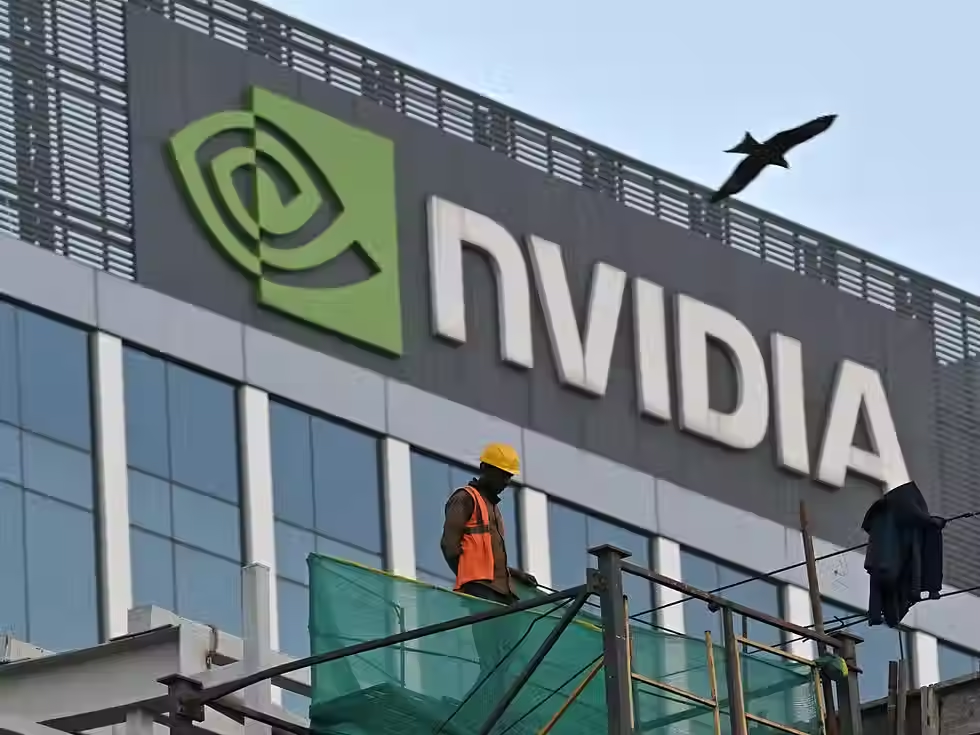
Companies such as Nvidia, which designs the high-performance chips that power AI training
and inference, have become critical gatekeepers of computational capacity. Meanwhile, OpenAI and similar research labs remain at the forefront of model development, attracting strategic backers seeking both influence and long-term integration advantages.
It is therefore unsurprising that OpenAI, which has seen extraordinary growth in recent
years, has drawn substantial investment from industry giants including Microsoft, Nvidia and Amazon. Last September, Nvidia announced a proposed $100bn multi-year partnership with
OpenAI, under which it would invest in ten increments of $10bn as OpenAI’s computing needs expanded. In return, Nvidia was set to receive a significant stake in the start-up.
OpenAI, for its part, planned to purchase millions of Nvidia’s AI processors to support the deployment of up to 10 gigawatts of new computing capacity.
However, the companies have since stepped back from that arrangement and are now
closing in on a revised $30bn investment, part of a broader funding round expected to raise
more than $100bn and value OpenAI at approximately $730bn. Much of OpenAI’s anticipated new capital is expected to fund the expansion of data centres and equip them with the most advanced processing chips available. In doing so, the company aims to push model capabilities further and help set the global benchmark for next-generation AI technology.
Heavy investment in AI companies has already translated into striking financial performance.
As partnerships with AI developers continue to generate substantial returns, major technology players are racing to secure access to cutting-edge AI products and computing capacity, viewing them as critical engines of corporate growth.
Yet this agreement is not merely a standalone collaboration between two technology leaders.
It reflects a broader narrative of how firms are positioning themselves to capitalise on the AI
industry’s rapid expansion. According to an analysis by Bridgewater Associates, tech giants
such as Alphabet, Amazon, Meta, and Microsoft are expected to collectively invest about
$650bn in AI-related infrastructure, a sharp increase from $410bn invested in 2025.
However, in a letter to clients, Bridgewater co-chief investment officer Greg Jensen warned
that the artificial intelligence boom has entered a “more dangerous phase,” characterised by exponentially rising investment in physical infrastructure and increasing reliance on external
capital. His remarks reflect growing unease about the durability of the current AI expansion.
Indeed, shares in Nvidia recently fell despite the company reporting record-breaking annual
revenues exceeding $200bn, fuelled largely by surging global demand for AI hardware and
data-centre infrastructure.
The muted market reaction suggests that Nvidia’s strong results were not enough to dispel fears of a potential market bubble, with investors questioning the long-term sustainability of the investment surge and expressing concern over the industry’s heavy dependence on a relatively small group of major AI providers.
"Computer demand continues to significantly outpace supply, driving hyperscalers to invest
even more rapidly to try to someday get ahead of the demand."
The four companies have already curbed share buybacks more aggressively to help fund the
surge in capital expenditure, Jensen added.
As tech firms pour billions of dollars of capital into AI providers, the growth in expenditure on
AI systems could lead to a hyper-dependency on AI providers which may undermine growth if
these systems fail, as well as posing a risk of a market bubble occurring, if investment and
valuations outpace realistic expectations of future profits.


Comments