


OpenAI Shuns Spectators inTrillion-Dollar AI Deal Spree, Stoking Investor Concerns

OpenAI CEO Sam Altman knows that advancing as far as possible in the AI industry race does not come cheaply, nor does it happen quickly. He and a small team of executives have completed roughly $1.5bn worth of investment deals with little input from external advisors. These deals involved lengthy negotiations with tech giants such as Microsoft, Nvidia, Oracle and AMD, drawing concern from investors about the perceived lack of financial planning during these operations.
This pattern of rapid investment into major AI infrastructure projects, carried out without external advisors, has also caused internal friction within OpenAI’s leadership. A senior executive, Caitlin Kalinowski, left the company following its deal with the United States Department of Defense earlier in February. The agreement allowed the U.S. military to use OpenAI’s technology in classified operations.
Since then, OpenAI says it has agreed to changes to what some critics described as an
“opportunistic and sloppy” deal with the U.S. government. These concerns centered on the
lack of guarantees that the Department of Defense would not use OpenAI’s technology
systems to spy on American citizens.
Because OpenAI negotiated these mega-deals without the typical advisory process used in major corporate decisions, while simultaneously signing sensitive national security contracts, the Pentagon agreement triggered backlash both inside and outside the company.
“This wasn’t an easy call,” Kalinowski, formerly the leader of OpenAI’s robotics division, said in a post on X.“AI has an important role in national security. But surveillance of Americans
without judicial oversight and lethal autonomy without human authorisation are lines that
deserved more deliberation than they got. This was about principle, not people.”
Kalinowski added that the issue was fundamentally about governance. “It’s a governance concern first and foremost,” she said.“These decisions are too important for deals or announcements to be rushed,” highlighting concerns about the lack of care in OpenAI’s deal- making process.
OpenAI’s massive infrastructure ambitions have already forced the company to temper its
projections. According to reporting by CNBC, OpenAI recently told investors it is targeting
roughly $600 billion in total spending by 2030, significantly lower than earlier discussions of
$1.4 trillion in AI infrastructure investment. To put that into perspective, OpenAI made just $13.1bn in 2025, while also burning through $8bn in the same period. The revised target is
intended to better align the company’s spending with its expected revenue growth, which
OpenAI projects could exceed $280 billion annually by the end of the decade.
The adjustment reflects mounting investor concern that the company’s earlier expansion plans may have been too aggressive relative to its projected earnings, reinforcing fears that the rapid pace of OpenAI’s dealmaking could outstrip its financial foundations.
In regard to the unconventional approach that Altman has taken to decision-making within
OpenAI, executives have stated that their goal is to stimulate the manufacturing and sale of
as many chips as possible within the shortest amount of time, with the intention of working
out financial specifics at a later period.
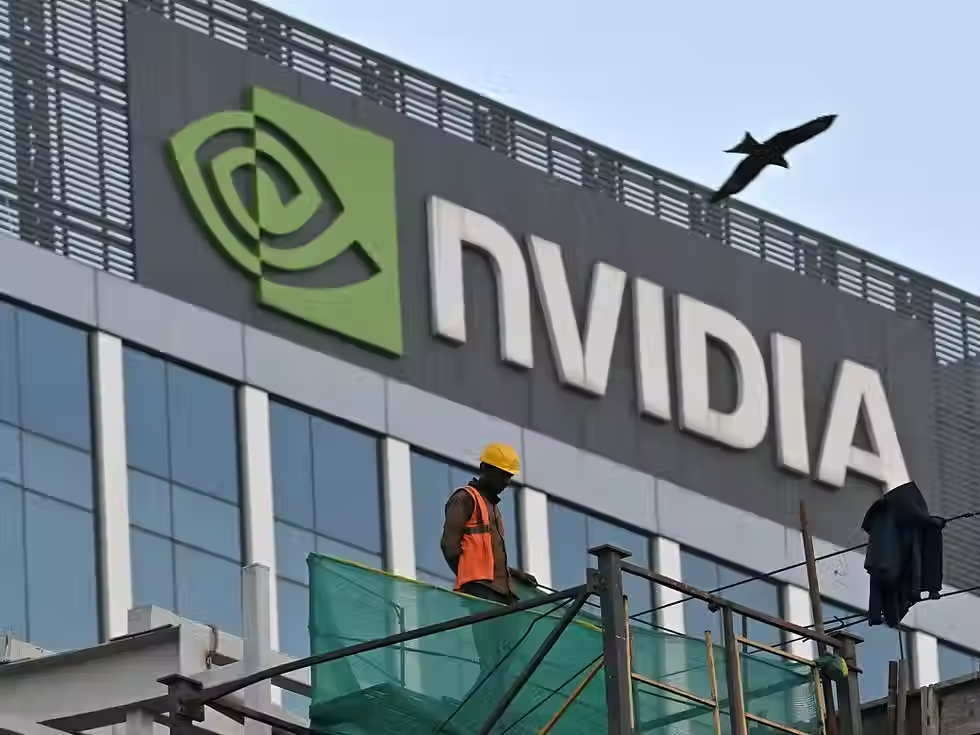
Neither Nvidia nor OpenAI sought external advice on their transaction in which Nvidia
agreed to invest up to $100bn in OpenAI in exchange for it spending as much as $350bn on
10GW of chips, according to people close to both companies. People close to the process
said that Altman was pitching very bold visions for these deals within the team, where most
of the structuring and governance was being worked out.


Comments